
Reviewed · ATHENS WINE TOURS
Biblical Corinth Taste Faith & History with wine & Oil Tasting
Corinth packs an unusual amount into a half-day: a modern canal, an ancient shipway, Roman ruins, the world of Saint Paul, and a mountain fortress with broad views. The private vehicle keeps the route comfortable, while drivers such as Nikos, Panos, Periklis, Andreas, and Christos add history and local judgment along the way.
I like the mix of biblical context and ancient sites, and I like the freedom to stop for food, photos, or a different drop-off point. The small-group format, limited to your own party in a sedan or minivan, also feels far more personal than a large coach excursion.
The main caution is timing. Five hours is tight for Corinth, the museum, lunch, Acrocorinth, and tastings. Entrance fees and food are extra, and the Ancient Corinth site can occasionally close without much warning, so confirm the day’s access before you leave Athens.
Key points to know before booking
- A private ride for up to seven people: You travel in a sedan for one to three people or a minivan for four to seven, with pickup and return in Athens.
- A strong Saint Paul connection: Corinth is tied to the two New Testament letters and Paul’s missionary work in the area.
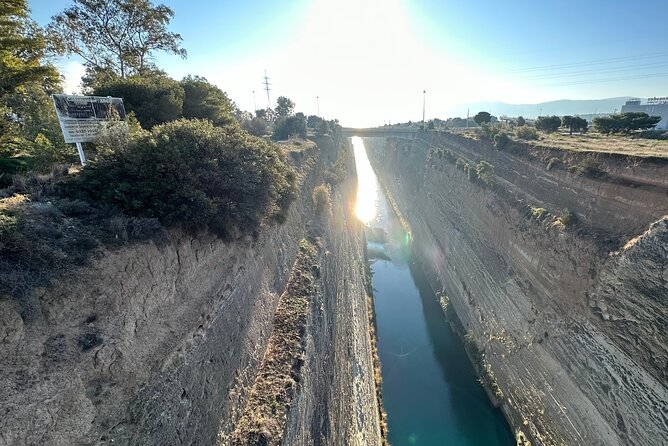
- The Corinth Canal is a quick but memorable stop: You see the narrow cut that saves ships about 185 nautical miles around the Peloponnese.
- Acrocorinth delivers the biggest view: The old fortress rises above the ancient city and once guarded the route into the Peloponnese.
- Wine and oil tastings cost extra: Wine is listed at €15 per person, while oil tasting with finger food is listed at €80 per person.
- The route is flexible, but not limitless: Drivers can adjust stops, yet a five-hour schedule may require choosing between longer ruins time, lunch, and tasting.
Why Corinth makes a strong half-day from Athens

Corinth sits at the narrow land bridge joining mainland Greece to the Peloponnese. That position made it a prize for traders, armies, and rulers. With water, farmland, export goods, ports, and control of the isthmus, the ancient city grew into one of Greece’s major powers.
The setting also gives this tour a clear story. You begin with engineering and shipping at the canal, move into ancient transport at the Diolkos, connect the area to the Isthmian games and Saint Paul, then reach Ancient Corinth and its Roman remains. Acrocorinth finishes the day high above it all.
I find that sequence useful because the stops do not feel like disconnected ruins. The canal explains the geography. Ancient Corinth explains the city’s wealth. Acrocorinth explains why the location mattered so much to anyone trying to control southern Greece.
The biblical side is not a quick label added to an archaeological outing. Paul’s time in Corinth is part of the area’s identity, and the tour connects his work to the Isthmian region, where the second major athletic games of the ancient Greek world were held after Olympia.
More History Tours in Athens:
- Douro Valley: Historical Sites, Wine Experience, Lunch & Cruise
★ 5.0 · 5,133 reviews - Barcelona: Tapas Walking Tour with Food, Wine, and History
★ 4.8 · 4,261 reviews - Sevilla Food Tour: Tapas, Wine, History & Traditions
★ 5.0 · 3,468 reviews
A private ride that keeps the day simple
Pickup is offered from an Athens hotel, Airbnb residence, or port. At a hotel, the driver waits in the lobby. At an apartment, the meeting point is the building entrance. Port pickup takes place at the gate, with a name sign. Airport pickup is also possible for an additional €60 per person, with the driver waiting in the arrivals hall.
For one to three people, transportation is by luxury sedan. Parties of four to seven use a minivan. The vehicles include air conditioning, WiFi, and bottled water, and fuel and tolls are included.
This matters because Corinth is not a casual walk from central Athens. A private car saves you from figuring out regional transport and lets the driver place the stops in a sensible order. You can also request a different return point, which is handy if you want to finish somewhere other than your original pickup spot.
The driver is an English-speaking tour driver rather than automatically a licensed guide. That distinction matters. The drivers have been praised for clear explanations and good local advice, but a licensed guide is optional, costs an additional €140 per person, and depends on availability.
Drivers named in past bookings include Nikos, Panos, Periklis, Andreas, and Christos. Periklis was especially appreciated for adding a lesson about the Battle of Marathon, while Andreas helped a customer adjust the route for a Zulu bungy jump. These details suggest useful flexibility, but you should state your priorities at booking rather than assume every driver will offer the same custom route.
The Corinth Canal and the ancient Diolkos
The Corinth Canal takes about 15 minutes. That sounds brief, but the view is worth the stop. The waterway cuts through the Isthmus of Corinth and links the Gulf of Corinth with the Saronic Gulf. In practical terms, it separates the Peloponnese from mainland Greece, making the peninsula an island in geographic terms.
The canal was completed in the late 19th century, yet the idea is far older. Ships once had to circle the Peloponnese to move between the Aegean and Adriatic routes, adding about 185 nautical miles. Periander, the ruler of Corinth, is said to have considered digging a canal around 602 BC, but the technology was not ready.
Instead, ancient builders created the Diolkos, a paved trackway for hauling ships across the isthmus on wheeled platforms. You spend about 20 minutes here. The route ran roughly 6 to 8.5 kilometers and worked from about 600 BC into the first century AD.
I like the Diolkos because it gives you a practical glimpse of ancient problem-solving. Corinth did not simply sit beside a useful waterway. It found a way to move vessels and cargo over land. The road also helped naval campaigns move faster during war.
These two stops work best with a good explanation from the driver. The remains are not as instantly dramatic as a temple, so context makes the visit. If you want long photo time at the canal, mention that early, since the schedule has several major sites still ahead.
Isthmia, the games, and Paul’s Corinth
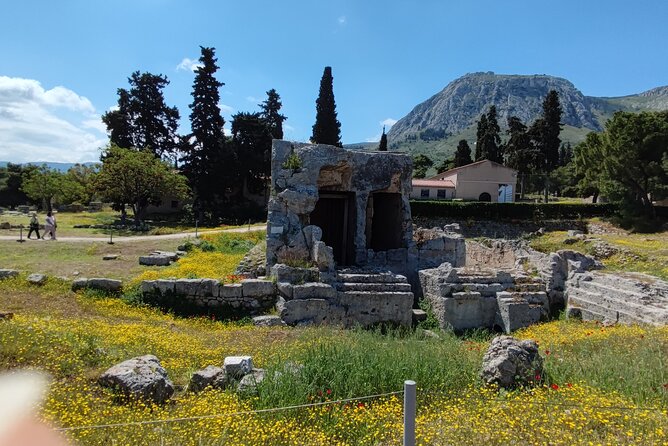
The Isthmia stop lasts about 30 minutes and introduces the athletic and religious side of the isthmus. The Isthmian Games were among the most important competitions in the ancient Greek world, ranking after the Olympic Games at Olympia.
This is also where the tour’s faith theme becomes more specific. Paul worked in the region as a tent maker, serving the athletes and visitors connected with the games while preaching Christianity. The setting helps you picture Corinth not only as a city of temples and trade, but also as a place where crowds arrived for sport, worship, commerce, and public debate.
The nearby Archaeological Museum of Isthmia takes about 20 minutes. Admission is not included. Its objects include a marble pediment from the first Temple of Poseidon, colorful glass panels from Alexandria, an imperial statue in the type of Zeus, commercial amphorae, animal figurines, and offerings connected with worship and warfare.
The glass deserves attention. The pieces show harbor views, exotic scenes, plants, animals, ships, geometric designs, and full-length figures such as Homer and Plato. For a small museum stop, that is a varied collection.
The visit is short, so you will not have time to study everything at length. Still, it adds useful detail to the open-air sites. The museum shows the objects that supported trade, religion, and daily life, while the ruins show the larger setting.
More Wine Tours in Athens:
- Athens: Classic Cooking Class with Market Visit and Wine
★ 5.0 · 1,101 reviews - Athens: Food Market Visit and Cooking Class with Wine
★ 4.9 · 1,087 reviews - Athens: Swimming Cruise with Lunch, Wine & Live DJ on Board
★ 4.6 · 1,085 reviews - Best rated Acropolis Wine Tasting
★ 5.0 · 568 reviews
Ancient Corinth and the Temple of Apollo
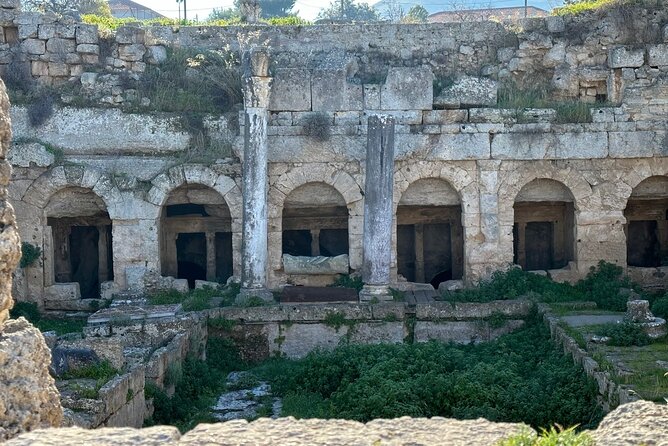
Ancient Corinth receives about an hour, followed by a visit to the Archaeological Museum of Corinth and the Temple of Apollo. Admission is not included, so check the current entrance arrangements before setting out.
The city’s scale was remarkable. Ancient Corinth is described as having about 90,000 people in 400 BC. Rome destroyed the Greek city in 146 BC, then founded a new Roman city on the same site in 44 BC. Corinth later became the provincial capital of Greece under Roman rule.
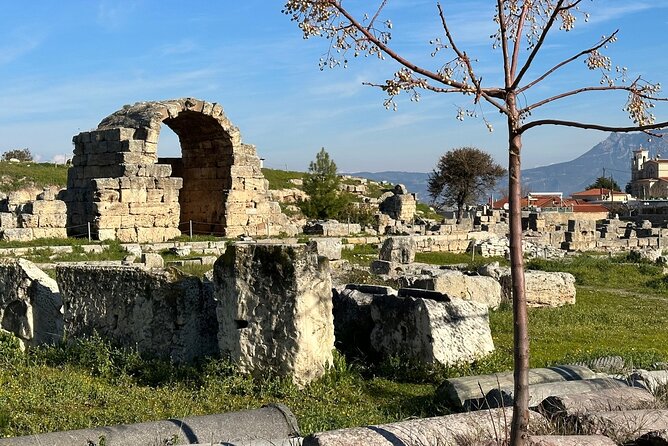
That layered past is the key to the visit. You are not looking at one frozen Greek settlement. You are seeing a place rebuilt and reshaped after conquest. The site includes the agora, Lechaion Road, the Fountain of Peirene, a basilica, a stoa, an odeon, and the Hadgimoustafa spring.
The Archaeological Museum of Corinth sits inside the archaeological site. It was built in 1931 and 1932 to display finds from excavations. The museum gives you a closer look at the people and objects behind the stone remains, though the exact visit time is only about 30 minutes.
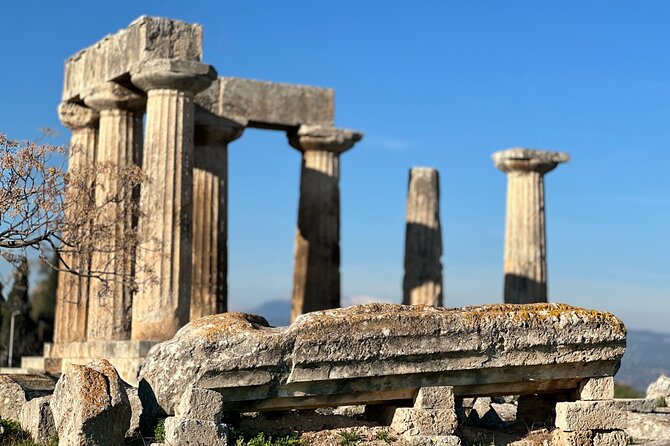
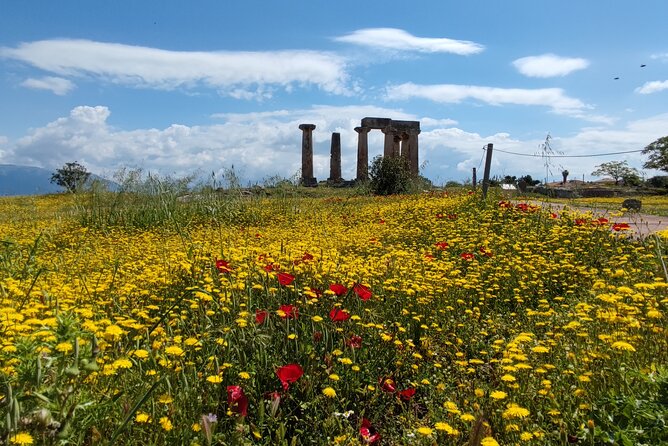
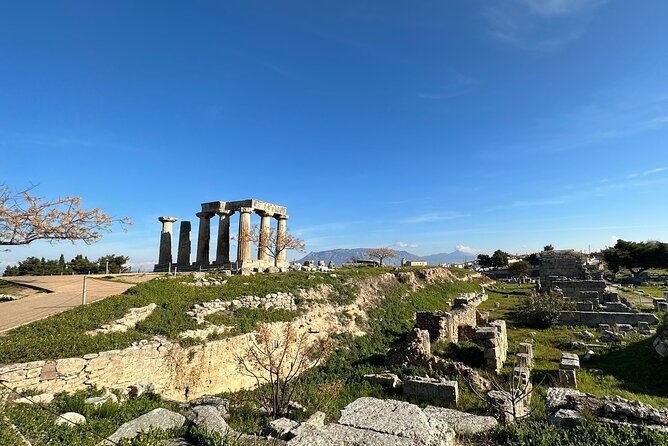
The Temple of Apollo is a short 15-minute stop. Built around 550 BC, it is one of the earliest Doric temples in the Peloponnese and on the Greek mainland. Its monolithic columns are an unusual feature and help explain why this building remains one of Ancient Corinth’s best-known sights.
The schedule gives you a useful overview, not an exhaustive archaeological study. If Ancient Corinth is your main reason for booking, ask for as much site time as possible and consider the optional licensed guide. If you prefer a broad introduction with several different stops, the one-hour visit fits the day well.
Lunch, shopping, and the climb to Acrocorinth
The itinerary allows about 45 minutes for lunch and shopping in the Ancient Corinth area. Food is not included. This is a practical pause, and past drivers have recommended lunch spots based on the day’s route.
Do not treat this stop as unlimited free time. With entry visits, the museum, and Acrocorinth still ahead, a long meal can squeeze the most scenic part of the day. Tell your driver if you prefer a proper lunch or a quick bite and more time at the fortress.
Acrocorinth receives about 30 minutes. The fortress sits on a large rock above the ancient city and commanded the isthmus. Its secure water supply made it a useful final defensive position, and different powers used it repeatedly to block entry into the Peloponnese.
This is likely to be your visual high point. The view explains Corinth’s importance more clearly than any map. From above, the city’s position between mainland Greece and the Peloponnese becomes obvious, and the ancient settlement below feels connected to the roads, ports, and passes around it.
Thirty minutes is enough for a quick look and photos, but it is not much time for a full exploration of the fortress. Wear shoes suited to uneven ground, though the supplied information does not specify trail conditions or accessibility. If Acrocorinth is your priority, say so when arranging the tour.
One past booking reshaped the route to include a Zulu bungy jump before visiting Acrocorinth. That does not mean the activity is part of the standard tour, but it does show that the private format can sometimes accommodate a special request if arranged ahead of time.
Wine and oil tasting: worth adding?
The title highlights wine and oil, but these tastings are not included in the base price. Wine tasting is listed at €15 per person. Oil tasting with finger food is listed at €80 per person, which is a major extra and deserves confirmation before you pay.
The tasting can make the day feel less like a string of ruins. It gives you a chance to connect the archaeological story to Greek food and agriculture. Still, you should ask exactly what the oil tasting includes, how long it lasts, and whether the €80 charge applies to each person. The supplied details do not explain the format.
At $190.46 per person, the tour is not a budget outing, especially once you add site fees, lunch, and optional tastings. The value improves for a small group because the price buys private transportation, pickup and drop-off, a flexible driver, and a route that would be awkward to arrange independently in five hours.
Admission is also not presented in one perfectly clear line. The tour information lists €15 for entrance fees to attractions and separately lists €15 for the Ancient Corinth archaeological site. Confirm the exact total, including the Isthmia and Corinth museums, before departure.
The optional licensed guide adds €140 per person. That may be worthwhile if you want formal archaeological interpretation at every major site. If you mainly need transportation, broad historical explanations, and help managing the day, the driver-led version may be enough.
Who should book this Corinth tour?
I would choose it if you want Corinth without renting a car or joining a large bus. It suits couples, families, and small groups who value pickup, air conditioning, a private schedule, and the ability to ask for a different lunch stop or return point.
It is also a good fit if Saint Paul matters to you. The tour connects the biblical story to the actual places around Corinth rather than treating it as a separate religious add-on.
History fans should like the range: the canal, Diolkos, Isthmian Games, museums, Roman city, Apollo’s Temple, and Acrocorinth. The tradeoff is depth. You see many places, but the five-hour limit prevents a slow archaeological study.
The tour has a 4.9 rating from 28 reviews, with 96 percent recommending it. The strongest pattern is the driver’s role. Nikos was praised for personal attention and choices, Panos for detailed explanations and careful service, and Christos for a friendly, informed day. One serious complaint involved arriving at a closed Ancient Corinth site on a Tuesday. The operator explained that an unexpected film closure caused the problem, but you should still confirm opening conditions close to your date.
Free cancellation is available up to 24 hours before the start time. Poor weather can lead to a different date or a full refund. Those terms are useful, but they do not remove the need to check site access before you go.
Should you book it?
Book this tour if you want a comfortable, private overview of Corinth with strong biblical and historical context, and if the price makes sense for your group size. The private vehicle and flexible driver are the real advantages.
Skip it if you want a slow day at Ancient Corinth, a guaranteed long museum visit, or a fully guided archaeological tour included in the price. In that case, request the licensed guide and ask for a longer itinerary.
My practical advice is to confirm four things before paying: the exact entrance total, the availability of the wine and oil tastings, the opening status of Ancient Corinth, and how much time can be reserved for Acrocorinth. Get those details right, and this makes a rewarding half-day beyond Athens.
FAQ
How long does the Corinth tour last?
The tour lasts approximately five hours.
Is hotel pickup in Athens included?
Yes. Pickup is offered from an Athens hotel, Airbnb residence, or port, with return to the original meeting point or another preferred location.
Can I be picked up from the airport?
Yes, airport pickup is available for an additional €60 per person. The driver waits in the arrivals hall with a sign showing your name.
How many people can join the private tour?
The tour is for your group only. Groups of one to three use a sedan, while groups of four to seven use a minivan.
Is the driver a licensed tour guide?
The included service provides an English-speaking tour driver. A licensed guide is optional, subject to availability, and costs an additional €140 per person.
Are entrance fees included?
No. Entrance fees are not included. The tour information lists €15 for attractions and separately lists €15 for the Ancient Corinth archaeological site, so confirm the exact total before departure.
Is lunch included?
No. A lunch stop is scheduled near Ancient Corinth, but the meal cost is separate.
Are wine and oil tastings included?
No. Wine tasting is listed at €15 per person. Oil tasting with finger food is listed at €80 per person.
Does the tour visit Acrocorinth?
Yes. The itinerary allows about 30 minutes at Acrocorinth, the fortress and acropolis above Ancient Corinth.
Can I cancel for a full refund?
You can cancel for a full refund up to 24 hours before the experience begins. Cancellations or changes made less than 24 hours before the start time are not refunded or accepted.
Newest wine reviews around Athens
- Athens: Wine Workshop Create your Own Wine under the Acropolis★ 5.0 · 77 reviews
- Athens: Greek Wines Tasting with Sommelier and Acropolis Views★ 5.0 · 88 reviews
- Wine Trails Private Tour/ Nemea visit 3 wineries from Athens or Nafplion (10 h)★ 5.0 · 44 reviews
- Small-Group Wine Tour in Athens with Tasting★ 5.0 · 33 reviews
- Mercedes Private Tour Nafplio, Corinth Canal, Nemea Wine Tasting★ 5.0 · 142 reviews
- Acropolis Private Wine Tasting @ Finewine store★ 5.0 · 46 reviews
- Sail the Athenian Coastline on a Catamaran with Meal & Wine★ 5.0 · 165 reviews
- Athens Riviera Private Sail Catamaran with Meal and Wine★ 5.0 · 30 reviews
Athens Wine Tours, compared.

Classic Cooking Class with Market Visit and Wine
Read our review →
Swimming Cruise with Lunch, Wine & Live DJ on Board
Read our review →
PREMIUM Semi-Private Athens Afternoon Food Tour & Wine Tasting
Read our review →


Wine Tasting with a Sommelier under the Acropolis
Read our review →
Premium Food and Wine Tasting Tour in the evening
Read our review →Lists this tasting appears in