
Reviewed · WINE TASTINGS
Trier: Guided City Walk with Wine Tasting
Trier’s best introduction may be a walk that pairs Roman monuments with Moselle wine. You move from the Porta Nigra to the Forum Baths, stopping at churches, market squares, palaces, and ruins while tasting a wine linked to the place or its local story.
I like the way the tour makes history easy to remember, and I like that the wine is not just an extra drink tacked onto a sightseeing walk. Guide Simon, who grew up in Trier, is especially good at answering questions and adding small details beyond the standard guidebook. The breadsticks, water, and five generous tastings also make the $43 price feel fair.
The main consideration is that you drink while walking and listening in public spaces. Noise can make a guide harder to hear, and the tour runs rain or shine. If you want a quiet winery visit with time for detailed tasting notes, this is not that experience.
Key points at a glance
- Porta Nigra to the Forum Baths: The route connects Trier’s most important central sights in about two hours.
- Five wines in warm months: Expect local wines with historical links to places around the city.
- Four mulled wines in winter: From mid-November through January, the focus shifts to seasonal Glühwein when at least six people register.
- Simon brings local knowledge: He grew up in Trier and combines city history with practical wine insight.
- An easy, barrier-free walk: No steps are required, and the route is wheelchair accessible.
- A useful extra at the end: You receive a voucher for one glass of wine with a main course at Weinwirtschaft Friedrich-Wilhelm.
Why wine makes Trier’s history easier to follow
Trier can feel like several cities placed on top of one another. Roman walls and bath ruins sit beside medieval churches, a grand baroque palace, and busy modern streets. A guide helps you connect those layers instead of seeing each monument as a separate photo stop.
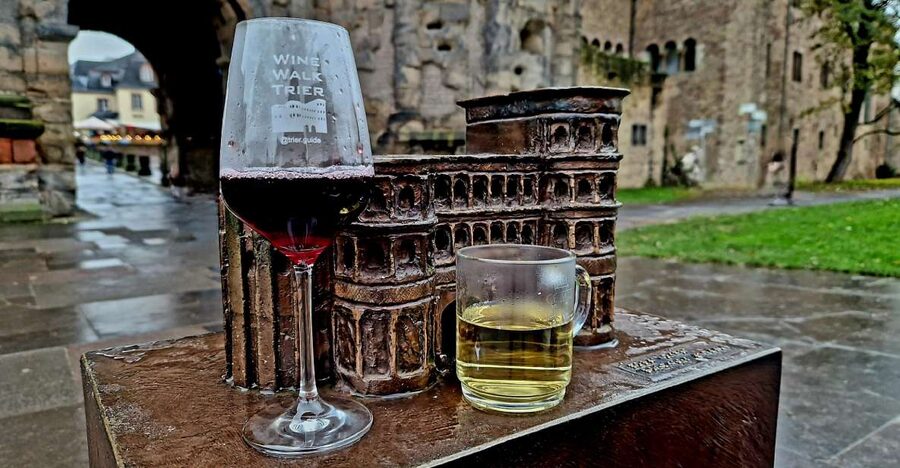
This tour adds a simple memory aid: a different wine appears as the walk reaches a new part of town. You are not only told that the Moselle region has a long wine tradition. You taste examples of it while learning why a particular building, square, or period matters.
That format works well for me because it keeps a two-hour city walk from turning into a list of dates. The wines create pauses, and the pauses give you time to look around, ask questions, and compare what is in your glass.
In warmer weather, you taste five regional wines. In winter, the experience usually changes to four local mulled wines from mid-November through the end of January, provided at least six people register. If fewer than six people sign up, the tour uses five different wines as it does in summer. Nonalcoholic grape juice can also be requested by email.
More Wine Tastings in Germany:
- Reil, Mosel: Guided organic wine tasting and cellar tour
★ 4.8 · 84 reviews - Berlin: Wine on Canvas – Paint Workshop and Wine Tasting
★ 4.7 · 59 reviews - Stuttgart: Stuttgart Wine Museum Wine Tasting
★ 4.7 · 55 reviews
Starting beneath the Porta Nigra
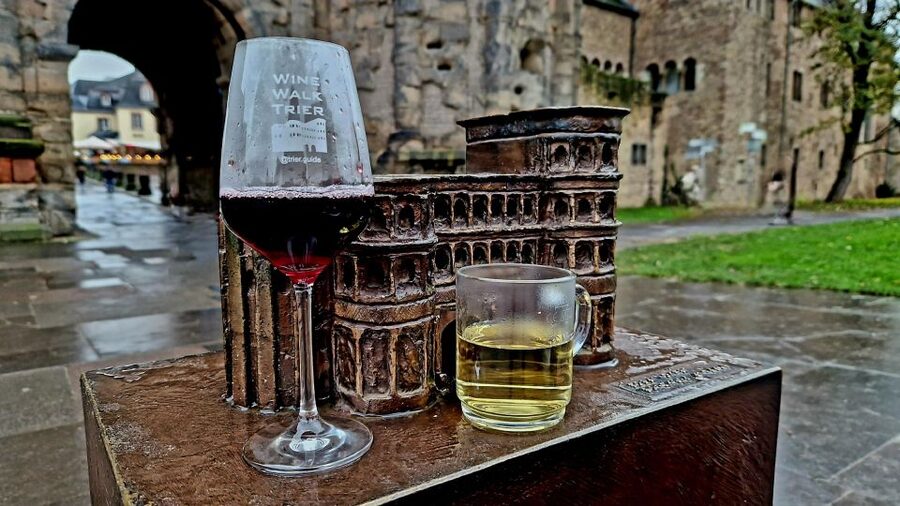
You meet on the left side of the Tourist Information office, in front of the city model near the flags. This is close to the Porta Nigra and easy to identify, but take care not to assume that the Tourist Information office operates the walk. The tour is run by Trier.Guide.
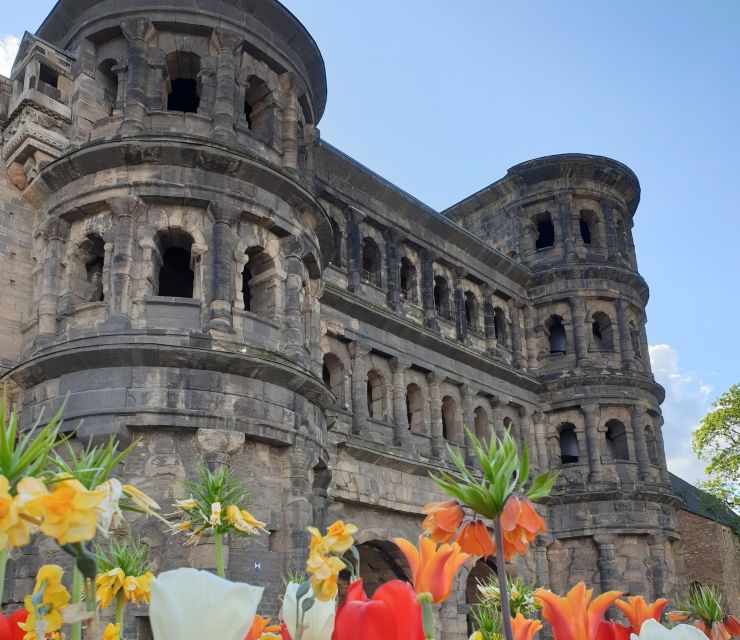
The Porta Nigra is a strong starting point. This dark Roman gate once formed part of the city’s defensive system, and it gives you an immediate sense of Trier’s age. The guide begins by placing the gate in the story of Roman Trier, then leads you into the pedestrian center.
The first wine tasting can take place around this opening part of the route. The exact pour and timing can vary, but the point is clear: the city’s ancient stonework and the Moselle wine country belong to the same regional story.
The route is not a hike. It is a city walk over roughly two hours, with frequent stops. You do not need to climb steps, and the entire tour is described as barrier-free. Still, city paving and public spaces can be tiring for anyone who has trouble standing for long periods, so comfortable shoes remain sensible.
Market Cross and Trier’s central square
From the Porta Nigra, the group moves toward the Market Cross on the Main Market. This is one of the best places to see how Trier changed from a Roman center into a medieval and modern city.
The square brings a different mood from the heavy Roman gate. Here, the guide can explain civic power, trade, and the role of the market in daily life. You get a useful contrast between an imperial entrance and a public square built around commerce and community.
This is also a good place for photographs. Do not treat the stop as only a quick backdrop, though. The value comes from hearing how the square fits into the city’s long development, then tasting another wine connected to the region.
The walk takes place in public areas, so you should expect some street noise and passing people. One participant found that the city’s activity sometimes made it hard to hear. I would stay close to the guide, especially at crowded stops, and ask for a repeat if a point gets lost.
Cathedral and Liebfrauenkirche
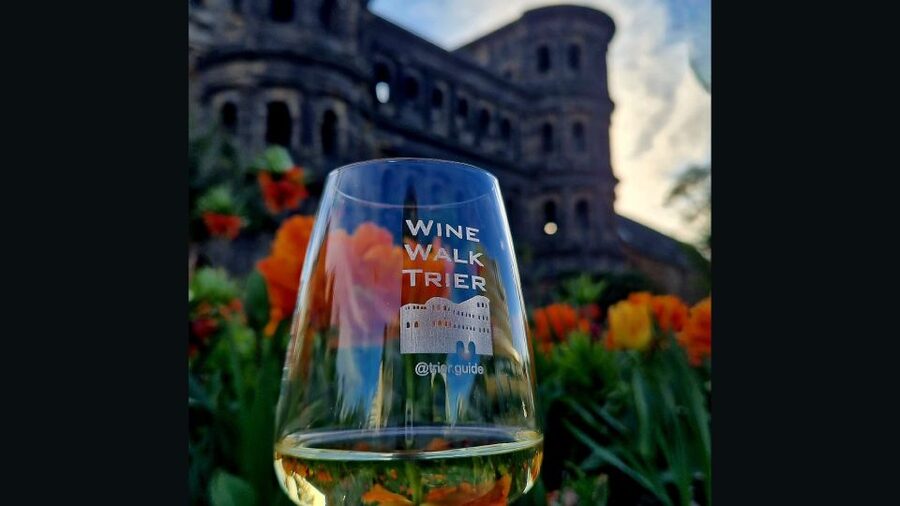
Trier Cathedral introduces the city’s Christian past. Its scale and long history give the guide a chance to explain how Trier’s religious importance grew after the Roman period.
Nearby, the Liebfrauenkirche offers a very different architectural impression. Its form and setting help show that Trier was not frozen in its Roman identity. The city kept changing, and these churches are part of that later story.
The tour includes guided commentary and photo stops, with wine served at selected points. Do not expect an extended interior visit at every monument. The walk is designed to orient you and explain what you are seeing, not replace a full museum or church visit.
That is one reason I recommend taking note of the places that catch your interest. The route gives you a useful first look, and you can return afterward for a slower visit if opening hours and access allow.
More Guided Tours in Germany:
- Stuttgart: Guided Wine Walk & Wine Tasting
★ 4.6 · 28 reviews - Koblenz: Historical Sparkling Wine Museum Guided Tour
★ 4.6 · 28 reviews - Rome: Guided Food Walking Tour with Wine in Trastevere
★ 4.9 · 3,105 reviews - Paris: Montmartre Cheese, Wine & Pastry Guided Walking Tour
★ 4.8 · 2,255 reviews
The Aula Palatina and Electoral Palace
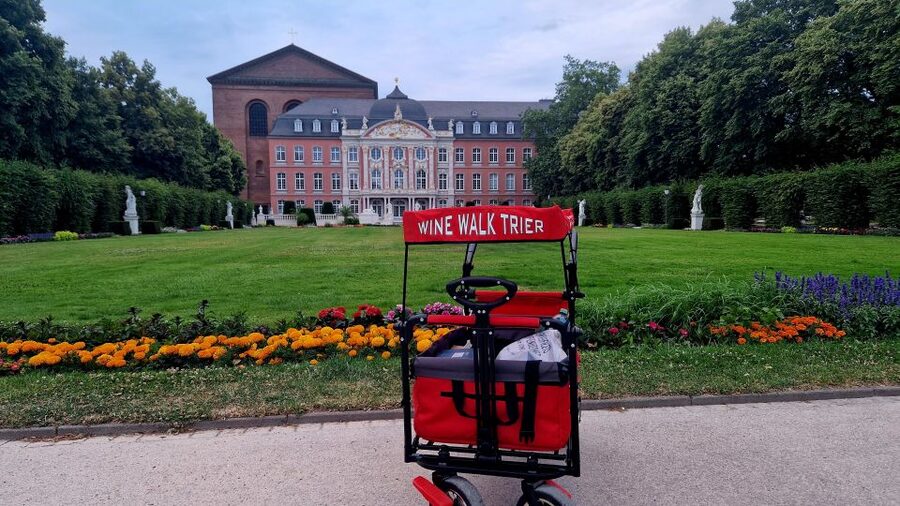
The Aula Palatina, also called the Basilica, is one of the tour’s strongest Roman stops. Its scale helps you picture the authority Trier held in the Roman world. The guide’s job here is less about reciting measurements and more about showing how the building fits into the city’s political story.
Beside it, the Electoral Palace adds a later layer of power. Its ornate appearance contrasts sharply with the plain, massive Roman basilica. In a short stretch, you see two very different ideas of authority: imperial Rome and the era of the prince-electors.
This pairing makes the walk more than a Roman ruins tour. You get a quick sweep through Rome, Christianity, medieval Trier, and later European politics. Several participants particularly valued the way Simon connected sites across different periods and pointed out details that are easy to miss on a first visit.
A wine tasting near the Electoral Palace adds another pause. The wine is meant to connect with a place or regional story, so listen for the explanation rather than treating the pour as a standalone tasting. You will get more from the experience if you ask about the grape, winery, and reason for the pairing.
Kaiserthermen and the Roman bath story
The Kaiserthermen are another major reminder of Trier’s Roman importance. These ruins once formed part of a large bath complex, and they help you imagine the public facilities and civic ambition of the ancient city.
The tour does not give you a long archaeological visit inside every ruin. Instead, the guide explains the site from the route and keeps the walk moving. That works well if you have only a day in Trier and want a broad introduction.
If you are passionate about Roman archaeology, you may want extra time at the Kaiserthermen and the other Roman monuments after the tour. The two-hour format gives you context and a route through the center, but it cannot provide a full archaeological study.
The pace is one of the tour’s strengths for first-time visitors. You cover a lot of ground without needing a separate plan for each sight. I would use the tour early in a Trier visit, then return to the sites you want to explore in more detail.
Ending at the Forum Baths
The walk ends outside the Forum Baths, another Roman bath complex in the city center. This is a fitting finish because the route begins with a Roman fortification and closes with Roman public life.
The final wine tasting can happen near this end point, and the guide leaves you with an easy place from which to continue exploring. The stop is not a hotel return, and there is no pickup or drop-off. Plan to make your own way onward from the Forum Baths.
You also receive a voucher for one glass of wine with a main course at Weinwirtschaft Friedrich-Wilhelm, next to the Basilica. That gives the tour a practical afterlife. You can use it to turn the walk into a meal, though the voucher is for the glass of wine with a main course, not a complete meal.
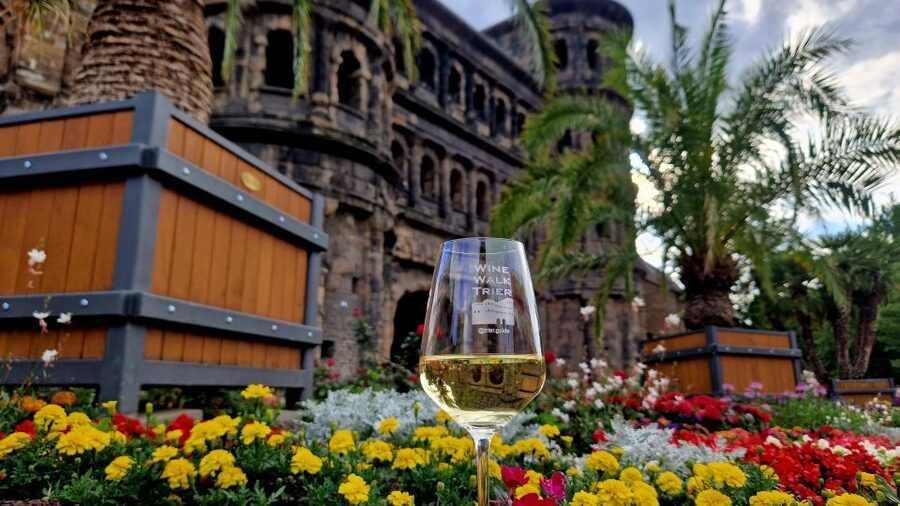
The glass used during tastings is not included as a souvenir. You can buy a glass afterward for €6, and a wine glass holder costs €3. These are optional extras, but budget for them if you want a keepsake.
What the wine tasting is really like
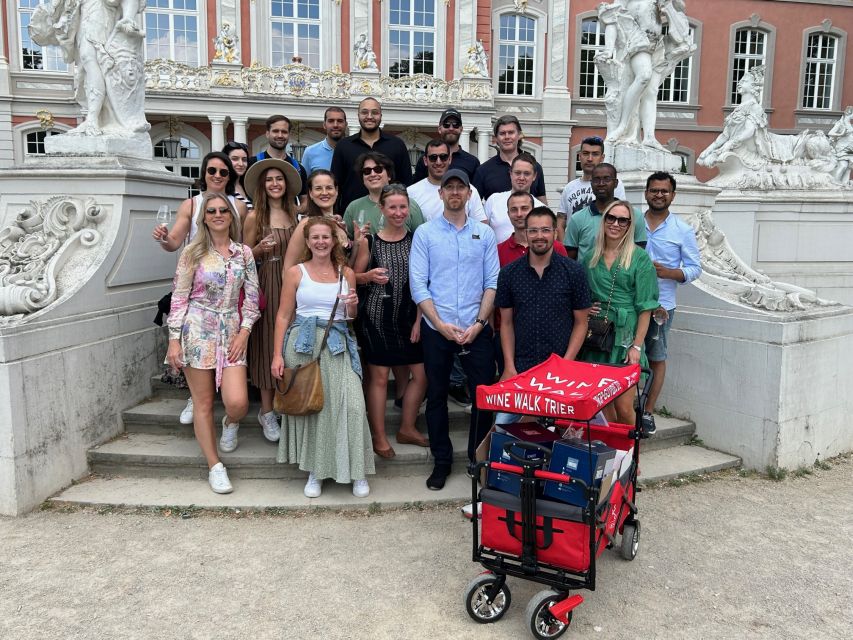
This is a tasting walk, not a formal cellar session. You sample five different wines during the summer season, with water and breadsticks provided. The wines are regional, and the guide explains their connection to the Moselle area and to places along the route.
The strongest part is the storytelling around each pour. You are given a reason for drinking that wine at that stop, which makes the tasting feel tied to Trier rather than pasted onto a standard sightseeing tour.
The selection has earned praise for its quality, including Rieslings and other local examples. Several people found the wines generous enough that the experience felt closer to enjoying wine than merely taking tiny technical samples. That is pleasant, but it also means you should pace yourself. Five pours over two hours can add up.
Winter changes the character of the experience. Four mulled wines from local wineries make sense in cold weather, and the warm drinks fit the streets and seasonal atmosphere. If fewer than six people register, the tour may use the regular five-wine format instead, so confirm the seasonal arrangement if the Glühwein element is important to you.
If you do not drink alcohol, grape juice can be arranged by email. That option makes the tour more useful for mixed groups, though you should request it before the walk rather than assuming it will be available on the spot.
Simon and the guide’s role
Simon receives repeated praise for his combination of humor, patience, and local knowledge. He grew up in Trier, and that personal connection comes through in the way he answers questions and explains less obvious details.
His approach appears to suit people who want both facts and conversation. He can cover Roman rule, the growth of Christianity, the Middle Ages, the world wars, modern Trier, and local wine without making the walk feel like a lecture.
Guide quality matters more here than on a simple landmark route because the wine pairings depend on explanation. A quiet or hurried guide would reduce the experience to drinks and photo stops. Simon’s friendly style, including patience with late arrivals and questions, is a real asset when he leads the group.
The tour is available in English or German. If the group gathers in a noisy part of the center, stay near the guide. That one small choice can make the difference between catching the full story and missing details while the wine is being poured.
Is $43 a fair price?
At $43 per person, the cost is reasonable if you want a guided orientation, five regional tastings, water, breadsticks, and a wine voucher. Buying five drinks separately could cost a fair portion of the price, while a private history walk would normally charge for the guide alone.
The value is strongest for a first visit to Trier. You see the main central landmarks, learn how the city’s periods connect, and get an introduction to Moselle wine without arranging transport to vineyards outside town.
The price is less compelling if you already know Trier well or mainly want a serious wine education. You are paying for the blend of city history, local stories, and tasting, not for long visits with winemakers or extensive time at one winery.
Free cancellation is available up to 24 hours before the start, and you can reserve without paying immediately. The tour runs rain or shine, so the price also includes a small weather gamble. Bring suitable clothing and do not count on moving indoors for the whole experience.
Who should book this walk?
I would recommend it to first-time visitors, day trippers arriving by train, couples, and small groups who want an easy way to combine sightseeing with local wine. It also suits anyone who likes history best when it is told through places rather than presented in a museum room.
The route works particularly well for people with only one day in Trier. You get an efficient sweep of the center, and the meeting point is close to the main city sights and convenient for an arrival from the station.
Wine lovers should book if they want an accessible introduction to Moselle wines alongside Trier’s monuments. They should skip it if their priority is vineyard scenery, cellar visits, or a technical tasting led entirely around grape varieties.
Families and mixed groups can also consider it because grape juice is available by prior email request. The alcohol still shapes much of the experience, though, so anyone uninterested in wine may find the central theme less appealing.
Should you book Trier’s wine tasting walk?
Book this tour if you want Trier explained in a clear, friendly way and you like the idea of matching local wine with Roman ruins, churches, squares, and palaces. The combination is the reason to choose it, and Simon’s local connection adds warmth when he is your guide.
I would schedule it near the beginning of your stay, then use the final stop and wine voucher to decide what deserves a longer visit. Come ready to walk, listen in public spaces, and drink at a sensible pace. For $43, it is a strong choice for a compact first look at Trier and the Moselle wine culture behind it.
FAQ
How long does the Trier guided wine walk last?
The tour lasts two hours.
Where does the tour begin?
Meet on the left side of the Tourist Information office, in front of the city model near the flags. The meeting point is close to the Porta Nigra.
Where does the tour finish?
The walk ends outside the Forum Baths in Trier.
Which languages are available?
The live tour guide is available in English and German.
How many wines are included?
The tour includes five different regional wines in the summer. From mid-November through the end of January, it normally includes four local mulled wines when at least six people register.
Can I request a nonalcoholic option?
Yes. Four different grape juices can be arranged by email.
Is the route wheelchair accessible?
Yes. The tour is completely barrier-free and does not require you to climb steps.
What is included besides the wine?
The price includes the walking tour, guide, water, breadsticks, and a voucher for one glass of wine with a main course at Weinwirtschaft Friedrich-Wilhelm next to the Basilica.
Can I cancel the booking?
You can cancel up to 24 hours in advance for a full refund. You can also reserve now and pay later.
Newest wine reviews around Germany
- Sylt: Shell safari with boat | incl. Mussel tasting & 1 glass of wine★ 4.7 · 49 reviews
- Stuttgart: Guided Wine Walk & Wine Tasting★ 4.6 · 28 reviews
- Stuttgart: Stuttgart Wine Museum Wine Tasting★ 4.7 · 55 reviews
- Heidelberg: Hills and Wine Region Segway Tour★ 4.9 · 89 reviews
- Reil, Mosel: Guided organic wine tasting and cellar tour★ 4.8 · 84 reviews
- Mulled wine ride in the Leipzig New Zealand★ 4.3 · 43 reviews
- Lieser: Covered wagon ride, the rolling wine tasting with picnic basket★ 4.7 · 51 reviews
- Kröv, Mosel: Covered wagon ride through the vineyards with wine tasting★ 4.8 · 46 reviews
Wine Tastings, compared.
Douro Valley w/ Boat Tour, Wine Tasting & Lunch
Read our review →
Complete Douro Valley Wine Tour with Lunch, Wine Tastings and River Cruise
Read our review →
Small-Group Wine Tasting Experience in the Tuscan Countryside
Read our review →
Montserrat & Cogwheel Train, Gourmet Wine Tasting & Tapas/Lunch
Read our review →
Tuscany & Montepulciano Day Trip with Lunch & Wine Tasting
Read our review →
SMALL-GROUP Wine Safaris: Tuscan Wine Tasting Tours from Florence
Read our review →Lists this tasting appears in