Reviewed · WINE & FOOD PAIRINGS
Private Secret Venice Tour; Rialto Market, San Polo & Food and Wine tasting
Venice reveals its character around the Rialto Market, not just in the grand rooms of its palaces. This walking tour takes you past fish stalls, old trading quarters, tax offices, artisan streets, and the former red-light district of Carampane before settling you at an osteria for wine and cicchetti.
I like the way the tour connects everyday food with Venice’s commercial past. I also like the small-scale feel, with guides such as Christina, Georgia, Barbara, and Frederica praised for bringing local stories to quiet corners. The main drawback is value: at $257.05 per person for about two hours, the price is high, especially when the food stop is limited to one glass of wine and a light selection of snacks.
Key points to know before booking
- Rialto Market comes early: You see the fish and vegetable stalls while learning why this area powered Venice’s trade for centuries.
- Carampane adds a less polished side of Venice: The old red-light district gives the walk a sharper look at ordinary life and social history.
- The tasting is light, not a meal: Plan on wine and cicchetti at one osteria, rather than several food stops.
- The guide makes the difference: Christina, Georgia, Barbara, and Frederica received especially warm praise for their storytelling and local insight.
- The walk ends by the Rialto Bridge: You finish in a useful central location, though the stated meeting point is Campo San Bartolomeo.
- Allow extra time to find the start: Venice’s narrow lanes can confuse phone maps, so arrive early with a paper map or offline directions.
A useful first look at mercantile Venice
This is not a grand-palace tour. You will not spend the morning moving through ticketed interiors or waiting in security lines. Instead, the experience uses streets, canals, market stalls, and building exteriors to explain how Venice worked as a trading city.
That approach suits you if you want context for what you see while walking around the Rialto area. The guide can point out details that are easy to miss, such as the old relationship between warehouses, markets, canal traffic, tax offices, and merchant housing.
The focus is also more historical than culinary. Food is part of the story, but this is not a full tasting tour. You receive a glass of wine and a light serving of cicchetti, the small Venetian snacks often served in neighborhood wine bars. If you are hungry, eat beforehand or plan lunch afterward.
The experience is advertised as a private activity, with only your group participating. Yet the reported departures vary: some groups had two or four people, while others included five, six, seven, or up to ten. That may reflect different booking arrangements or departures. If complete privacy matters to you, confirm the group format before paying the full price.
More Wine and Food Pairings in Italy
- Eat, Drink and Repeat: Wine and Food Tasting Tour in Venice
★ 5.0 · 1,060 reviews - Venice: Sunset Walking Tour with Food and Wine Tastings
★ 4.9 · 848 reviews - Venice: Rialto Market Food and Wine Lunchtime Tour
★ 5.0 · 383 reviews
Meeting in Campo San Bartolomeo
The walk begins at Campo San Bartolomeo, a central square close to the Rialto Bridge. This is a sensible starting point because the area sits at the meeting point of Venice’s shopping streets, market lanes, and Grand Canal crossings.
Finding the exact square can take longer than expected. One account describes a 20-minute walk turning into a wide circle, even after allowing 45 minutes. Venice’s tall buildings and twisting lanes can confuse phone location services, so I would arrive at least 20 to 30 minutes early. Save the meeting point before leaving your hotel, and carry a simple paper map if you have one.
The tour operator provides confirmation at booking unless you book within two days of departure. Late bookings may receive confirmation within 48 hours, subject to availability. Hotel pickup is not included, so you must make your own way to Campo San Bartolomeo.
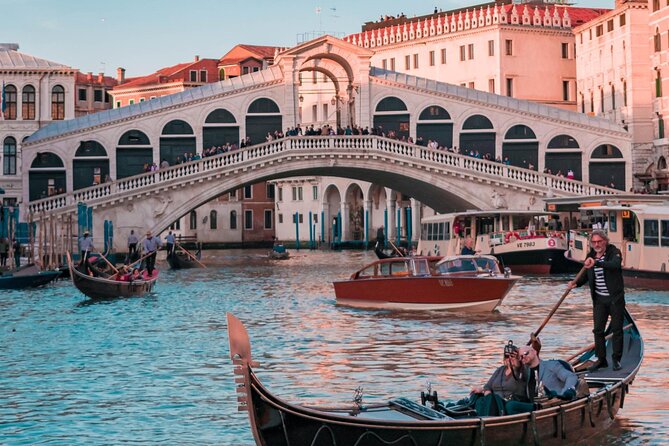
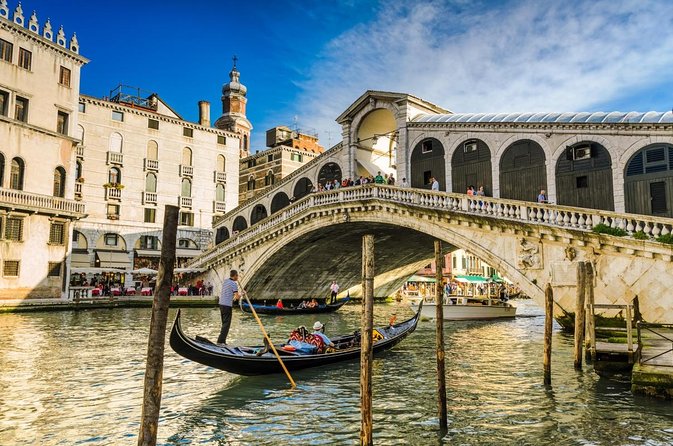
Rialto Bridge and the market district
The first section introduces the Rialto Bridge and the trading world around it. You spend about 15 minutes learning how the bridge and nearby buildings served medieval and Renaissance commerce.
The bridge is one of Venice’s most photographed sights, but the useful part of this stop is the explanation of what surrounded it. Rialto was not simply a crossing. It was the commercial center of the city, tied to merchants, money changers, market sellers, warehouses, and boats moving goods along the Grand Canal.
The guide also explains how Venice grew into a major commercial power. You begin to see the city less as a collection of beautiful façades and more as a working port and financial center. That background makes the canals and palaces easier to read later in your visit.
The stop is short, so do not expect a long presentation about every building. Its purpose is to set the scene before you enter the market area.
Rialto Fish and Vegetable Market
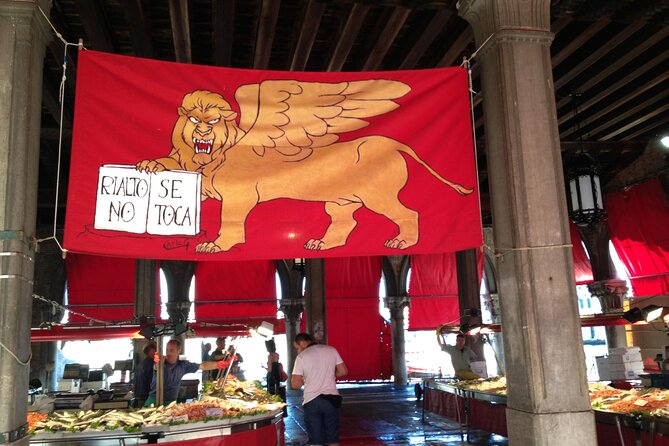
The market is the most vivid part of the route. You walk among stalls selling seafood and fresh produce while the guide explains the market’s long role in Venetian life.
The atmosphere changes with the hour and season. The official route gives this section about 50 minutes, including the osteria stop. That means the market itself may receive less time than you expect, particularly if the group pauses for questions or if conditions are crowded.
I would treat the market as a place to observe rather than shop. Look at the connection between the stalls and the Grand Canal, and pay attention to how close the food trade remains to the water. The setting helps you understand why Rialto became Venice’s main market from the 11th century onward.
This is also where the tour feels least like a standard sightseeing walk. You are not only looking at monuments. You are watching a part of the city’s daily rhythm and hearing how the market supported families, merchants, and workers over many generations.
Still, expectations matter. The market visit is not a cooking class, a guided food crawl, or a chance to sample every specialty. If you want a long morning of tastings, this tour will feel too light.
More Wine and Food Pairings in Venice
- Rialto Market Food and Wine Lunchtime Tour of Venice
★ 5.0 · 278 reviews
Cicchetti and wine at a neighborhood osteria

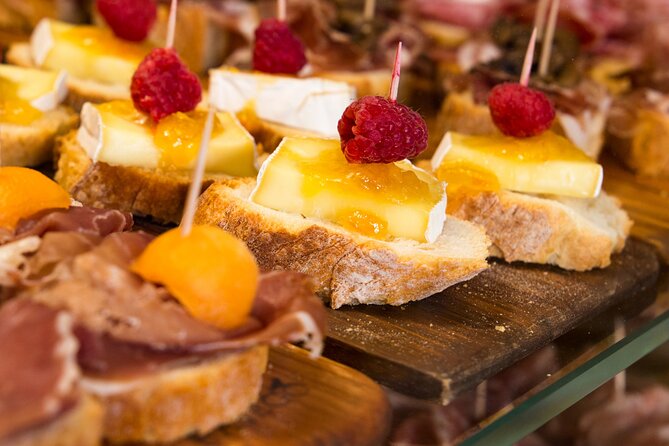
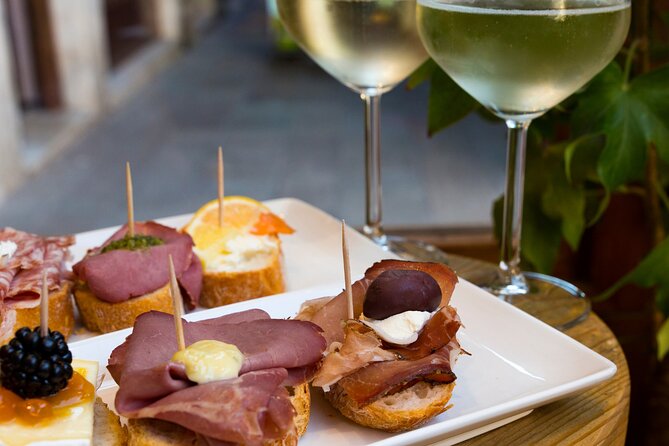
The food stop takes place at a typical osteria, where you receive a glass of wine and a light taste of cicchetti. These small snacks are a natural fit for Venice, where a quick bite and a drink can be part of an ordinary evening.
The stop usually provides two small bites per person according to one detailed account, though the exact selection can vary. You sit around a shared wooden table, which gives the group time to talk and slows the pace after the market walk.
I like this pause because it links the historical material to modern Venetian habits. You get a sense of how a local wine bar functions, even if the tasting is modest.
The limitation is clear: there is one food stop, not several. One person found the walking portion more satisfying than the wine and cicchetti section, expecting more stops from the title. At this price, that criticism is fair. Think of the osteria visit as a pleasant sample, not lunch.
If you have dietary restrictions, ask about the available cicchetti before booking. No specific dietary arrangements are stated, so you should not assume substitutions are included.
San Polo, Carampane, and the less polished city
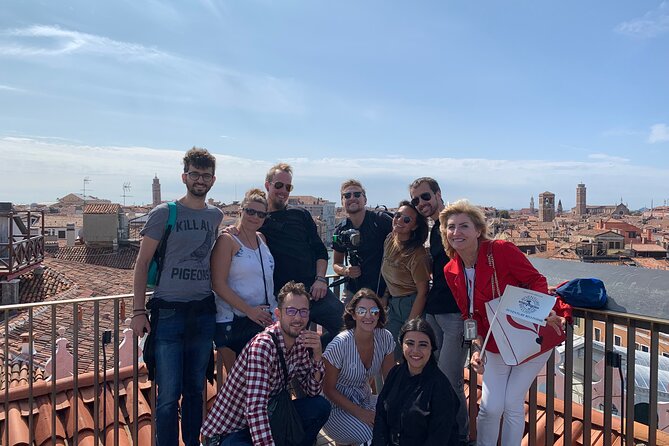
After the market, the route enters San Polo, one of Venice’s oldest districts. It has been settled since the ninth century and served as the city’s main market area from the 11th century.
This is where the walk moves away from the postcard version of Venice. The guide points out quieter streets, old artisan quarters, and parts of Carampane, the historic red-light district. The stories can be more revealing than another view of a church façade because they show how Venice handled work, trade, crime, and social rules.
Carampane also adds a little edge to the route. You hear about an area shaped by people who lived outside the respectable image of merchant Venice. The name and history give you a different way to understand the city’s crowded medieval neighborhoods.
The quality of this part depends strongly on the guide. Christina was singled out for her ability to explain Venice’s people and past, while Barbara was praised for lively stories and clear explanations. Other guides, including Georgia and Frederica, were described as warm, energetic, and able to point out streets that are easy to miss alone.
Not every departure will feel equally animated. A few accounts describe a guide who seemed tired or less engaged. That is a reminder that the experience is guide-led, not a fixed audio route.
Palazzo dei Camerlenghi and the Grand Canal
The walk continues toward Palazzo dei Camerlenghi, the ornate 16th-century building beside the Grand Canal. Its elegant exterior hides a harsher role: the building was associated with the financial administration of Venice and was feared as a prison for small-time tax evaders.
That contrast is one of the tour’s best details. Venice often presents beauty first, while the guide supplies the uncomfortable footnote. A palace beside the water could represent wealth, law, punishment, and bureaucracy all at once.
You also receive several views of the Grand Canal during the route. The canal is not treated as scenery alone. It becomes evidence of how Venice moved goods, controlled trade, and connected the districts that grew around it.
The official timing allows about 15 minutes for Grand Canal views and 30 minutes for San Polo. Those figures are approximate, and the pace can change with crowds, weather, and the guide’s storytelling.
T Fondaco dei Tedeschi and German merchant power
The final named stop is T Fondaco dei Tedeschi, a historic building facing the Grand Canal. It once served as the headquarters and living quarters of German merchants.
The building helps explain how international Venice really was. Foreign merchants did not simply pass through town. They needed offices, storage, homes, and official arrangements close to the city’s trading center.
You spend about ten minutes here, so the stop is brief. It works best as a final piece of the commercial story rather than a full architectural visit. If you want to go inside or explore the building independently, ask the guide how much free time you will have after the walk.
The tour finishes around the Rialto Bridge or back near the starting area, depending on the exact route and conditions. The published information identifies Campo San Bartolomeo as the meeting point and says the activity ends back there, while the route description places the conclusion by the Rialto Bridge. Since those locations are close, the difference is small, but confirm the end point if you have a timed reservation afterward.
Timing, walking, and weather
The advertised duration is about two hours. That is a good fit for your first day in Venice, when you want an introduction without committing half a day.
Some departures have lasted longer, with one account describing about four hours and others ending after roughly 90 minutes. The difference may come from the guide, group pace, added stops, or confusion with other versions of the route. I would plan around the official two-hour timing, but avoid booking a train, museum, or restaurant immediately afterward.
You will walk on uneven paving through narrow streets and crowded passages. Comfortable footwear matters. The tour operates in most weather, and high water will not automatically cancel it, though part of the route may change.
Bring a light waterproof layer and dress for the season. If rain forces a change, the osteria may become a more important shelter stop, but the exact adjustment depends on conditions.
How much value do you get for $257.05?
At $257.05 per person, this is an expensive walking tour. The price makes the most sense for a small private group that values a personal guide and wants historical interpretation rather than a basic orientation walk.
For two people, the cost is substantial. For a larger private group, the per-person value may improve if the price is fixed or discounted by group size. Group discounts are listed, but the exact rates are not provided, so check the final booking price carefully.
You are paying for three things: the guide’s time, access to a focused route through old Rialto and San Polo, and the convenience of pairing history with a wine and cicchetti stop. You are not paying for admission to museums, a full meal, hotel transport, or multiple tastings.
I would compare the price with your priorities. If you want a local guide who can explain Venice’s trading system, point out overlooked streets, and answer questions as you walk, the cost may be worthwhile. If your main goal is food, you can likely find a longer cicchetti tour for better value. If you only want to see the Rialto Bridge and market, you can do that independently.
Who will enjoy this walk most?
I would recommend it to first-time visitors who want to understand Venice before exploring on their own. It also suits repeat visitors who have already seen St. Mark’s Square and want a closer look at San Polo and the market district.
The tour works well for couples, families with older children, and small groups who prefer conversation over a large scripted walk. The guide can adjust the focus more easily when the group is small.
It is less suitable if you have limited mobility, dislike uneven streets, or want to sit frequently. Most people can participate, but the route is a walking experience and no special accessibility arrangements are stated.
It is also not ideal for anyone expecting a half-day food tour, a full private tour of interiors, or a guaranteed gondola ride. Some departures have included a short gondola crossing or a visit connected with the Frari area, but these are not part of the core description and should not be treated as promised features.
Should you book it?
Book this tour if you want Venice explained through its markets, merchants, taxes, canals, and less polished neighborhoods. The strongest reason to choose it is the guide-led storytelling, especially when you are matched with someone as engaged as Christina, Georgia, Barbara, or Frederica.
Skip it if $257.05 feels too steep for a two-hour walk with a light tasting. You can visit the Rialto Market and cross the bridge yourself, then spend the savings on a longer meal.
For the best experience, schedule it early in your Venice stay. You will gain useful bearings for later walks, and the market, San Polo lanes, Carampane stories, and osteria stop give you a strong first look at the city beyond its headline sights.
FAQ
How long does the Private Secret Venice Tour last?
The advertised duration is approximately two hours. The exact pace can vary with weather, group size, and the guide.
Where does the tour begin?
The meeting point is Campo San Bartolomeo, Campo S. Bortolomio, 30124 Venezia VE, Italy.
Where does the tour end?
The published information says the activity ends back at the meeting point, while the route description also identifies the Rialto Bridge as the conclusion. These areas are close together, but confirm the exact ending point if you have plans immediately afterward.
Is food included?
Yes. The tour includes a light taste of cicchetti and wine at a local osteria. It is not described as a full meal or a multi-stop food tour.
Is this a private tour?
The activity is described as private, with only your group participating. Group sizes reported for different departures vary, so confirm the arrangement if you require a fully private experience.
Is hotel pickup included?
No. You must make your own way to Campo San Bartolomeo. The area is near public transportation.
Can I cancel for a full refund?
Yes, if you cancel at least 24 hours before the experience’s local start time. Cancellations or changes made less than 24 hours in advance are not refunded, and a minimum number of participants is required for the experience to operate.
More Wine Tastings in Venice
- From Porto: Douro Valley w/ Boat Tour, Wine Tasting & Lunch
★ 4.7 · 19,061 reviews - Complete Douro Valley Wine Tour with Lunch, Wine Tastings and River Cruise
★ 5.0 · 12,920 reviews - From Split: Krka Waterfalls, Food & Wine Tasting Tour
★ 5.0 · 9,326 reviews - From Split: Krka Waterfalls, Food & Wine Tasting Tour
★ 4.9 · 6,598 reviews
More Wine Tastings in Italy
- From Venice: Prosecco Hills and Wine Tasting Tour
★ 4.9 · 357 reviews - A Venetian Evening: Wine Tasting and Cicchetti with a Local Guide
★ 5.0 · 146 reviews - Florence: Chianti Wineries Tour with Wine Tasting
★ 4.5 · 10,071 reviews - Small-Group Wine Tasting Experience in the Tuscan Countryside
★ 5.0 · 7,392 reviews
Newest wine reviews around Venice
- From Venice: Dolomites and Prosecco Hills Day Trip with Wine★ 5.0 · 117 reviews
- Amarone Wine Tour & Tasting from Venice, Padua or Verona★ 5.0 · 35 reviews
- A Venetian Evening: Wine Tasting and Cicchetti with a Local Guide★ 5.0 · 146 reviews
- Rialto Market Food and Wine Lunchtime Tour of Venice★ 5.0 · 278 reviews
- Venice: Rialto Market Food and Wine Lunchtime Tour★ 5.0 · 383 reviews
- Private Prosecco , Hilltowns & Palladian Villa Tour from Venice★ 4.5 · 221 reviews
- From Venice: Prosecco Hills and Wine Tasting Tour★ 4.9 · 357 reviews
- From Venice: Prosecco Wine Region Tour with 2 Tastings★ 5.0 · 374 reviews
Wine & Food Pairings, compared.
Pisa, Siena and San Gimignano Day Trip with Lunch & Wine Pairing
Read our review →
Montmartre Hill French Gourmet Food and Wine Tasting Walking Tour
Read our review →
Rome by Night – Ebike Small Group Tour – Food and Wine (Option)
Read our review →
Vila Nova de Gaia: Port Wine Tasting with Cheese Pairing
Read our review →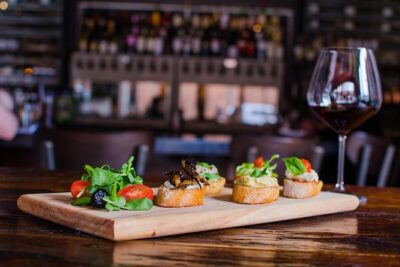
Eat, Drink and Repeat: Wine and Food Tasting Tour in Venice
Read our review →